
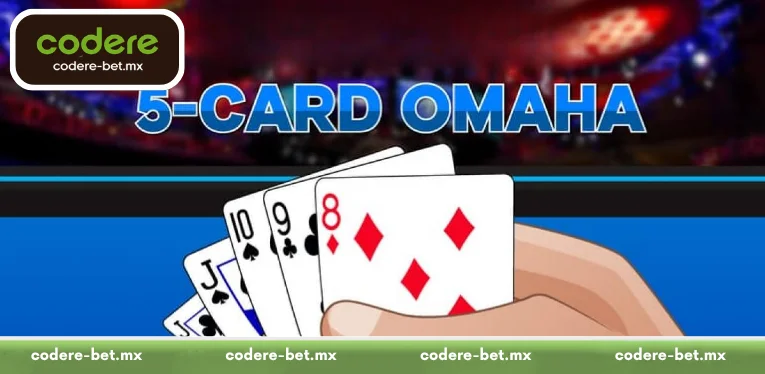
In the rapidly expanding world of professional card games, 5 Card Omaha has emerged as the ultimate frontier for players who find traditional variants too simple. For the high-stakes community in Mexico, this “Big O” style of play offers a massive increase in hand combinations, leading to some of the largest pots and most intense draws in the industry. While the leap from two or four cards to a five-card starting hand may seem subtle, it fundamentally shifts the mathematical landscape of the game. At Codere, we provide a premium digital arena where the complexity of five cards is managed with intuitive software and local financial security. This guide explores the unique mechanics of the game, the professional rules of hand construction, and the critical decision-making processes required to dominate the lobby.
Overview of 5 Card Omaha
5 Card Omaha is a community-card game that pushes the boundaries of traditional poker logic. Just like its four-card predecessor, it is most commonly played in a “Pot-Limit” format (PLO5). The core difference is simple yet profound: every player receives five private hole cards instead of the usual two or four. This single extra card creates a geometric explosion in the number of potential two-card combinations available to every participant.
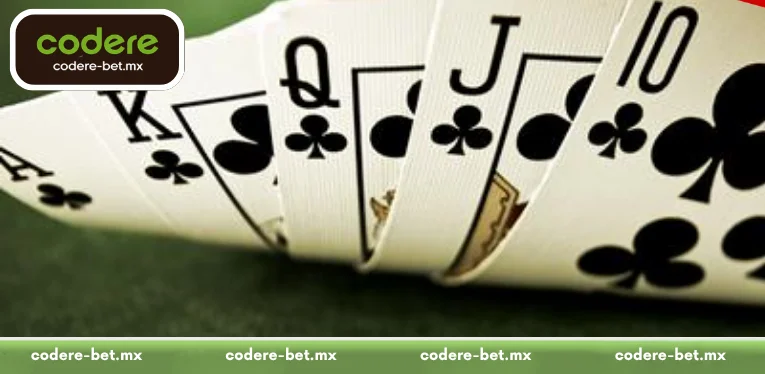
For players in Mexico, the appeal of this variant lies in its “Action-Heavy” nature. In 5 Card Omaha, it is much easier to flop a powerhouse hand, but it is equally likely that your opponent has also hit something significant. It is a game of “Ultra-Incomplete Information,” where you must navigate the board with extreme precision to ensure you are drawing to the absolute “Nuts.” Whether you are a veteran of the four-card tables or a newcomer seeking high-intensity action, the five-card environment at Codere provides a professional and intellectually rigorous experience for all members.
Hand Construction Mechanics in 5 Card Omaha
The transition to a five-card format requires a complete recalibration of how you evaluate hand strength. The additional card doesn’t just add variety; it changes the mechanical probability of every betting round.
The Mandatory Two-Card Rule
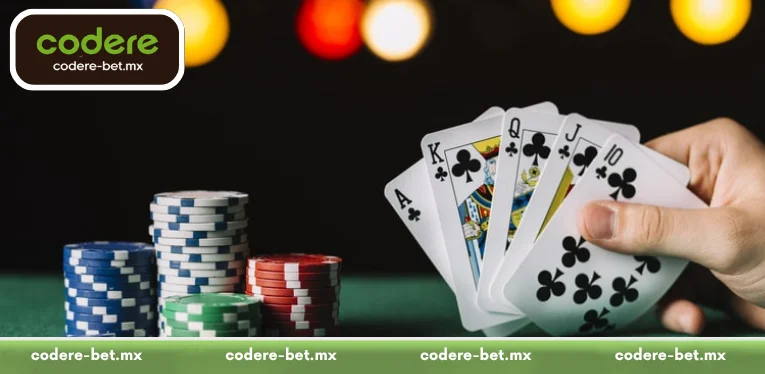
Just like in standard Omaha, the most critical rule in 5 Card Omaha is the “2+3” requirement. Many beginners make the mistake of thinking more cards in their hand gives them more flexibility, but the restriction remains rigid:
- The Rule: You must use exactly two of your five hole cards and exactly three of the community cards to form your final hand.
- The Mechanical Trap: If the board shows four Spades and you hold the Ace of Spades but no other Spade, you do not have a flush. You must have a second Spade in your five-card hand to qualify.
- Strategic Visualization: With five cards, it is easier to accidentally overlook this rule. Professional members at Codere train themselves to see their hand as ten distinct two-card combinations working simultaneously.
The Capability for Creating Massive Hands
In 5 Card Omaha, the average winning hand is significantly stronger than in any other variant.
- Frequency of Sets and Full Houses: Because you hold five cards, the mathematical chance of being dealt a pair or “Three-of-a-Kind” potential is much higher.
- The “Wrap” Draw: In this game, it is common to flop a “straight wrap” where you have up to 20 or even 24 “outs” (cards that will complete your straight). This creates massive equity on the flop, often leading to “All-in” confrontations before the turn is even dealt.
- The Nut-Flush Factor: Because players hold more cards, if a flush is possible on the board, someone almost certainly has it. Playing anything less than the “Nut Flush” (the Ace-high flush) is often a recipe for a financial loss.
Impact on Playing Style
The presence of a fifth card forces a shift from “Aggressive Blurring” to “Calculated Equity Play.”
- Tightened Pre-Flop Standards: You cannot simply play any five cards. You need “coordination”—where all five cards work together toward the same goal (e.g., A-K-Q-J-10 or 9-8-7-6-5 suited).
- Defensive Post-Flop Play: You must be more cautious when the board pairs. In 5 Card Omaha, a “Full House” is a standard hand, not a rarity.
- Pot Control: Because equities are so close, managing the pot size is a mechanical necessity. You want to build the pot when you have the “Nuts” and keep it small when you are on a draw.
Critical Decisions in Every Round
Success in the 5 Card Omaha lobby is determined by a series of high-pressure decisions. Unlike simpler games, one wrong choice here can lead to a significant “stack-off” against a superior hand.
To maintain a professional edge, members must focus on three core pillars of decision-making:
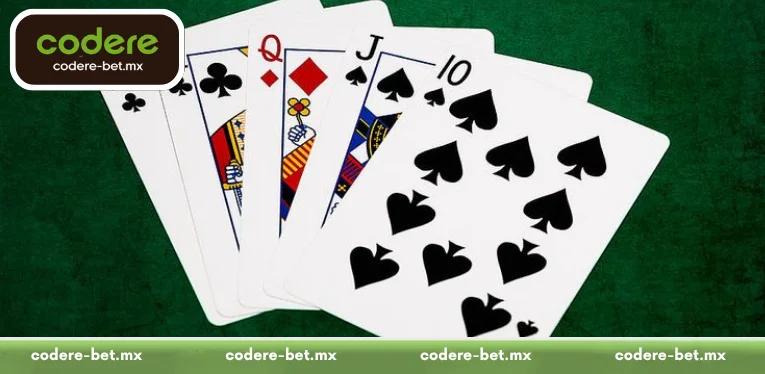
- Selecting the Starting Hand: The most important decision happens before the flop. Look for “Connectedness.” A hand like A-A-K-Q-J double-suited is the gold standard of 5 Card Omaha. Avoid hands with “Danglers” (cards that don’t fit the suit or sequence of the others), as they effectively turn your five-card hand back into a weaker four-card hand.
- Reading the Board and Adjusting Strategy: Every community card revealed on the board shifts the math instantly. In the Codere interface, you can see the pot size and your history. If the “Turn” card completes a possible straight, you must ask yourself: “How many of my opponents started with those two cards?” In 5 Card Omaha, the answer is usually “all of them.” Adjust your aggression based on the “Nut” potential of the board.
- Optimal Timing for Betting and Raising: Because it is a Pot-Limit game, you cannot always protect your hand with a massive over-bet. You must learn to “Lead Out” when you have a strong draw to build the pot, or “Check-Raise” when you have the absolute best hand to trap aggressive opponents. Timing your raises to maximize value while using local payment methods like SPEI or OXXO to keep your bankroll healthy is the hallmark of a pro.
Professional Infrastructure for Mexico Players
Engaging in 5 Card Omaha requires a platform that can handle complex multi-card visualizations and secure financial logistics.
- Mobile Optimization: Our software ensures that all five hole cards are clearly visible on your screen, with highlighted “Nut” potential to help you make split-second decisions.
- Localized Financial Security: Members in Mexico can deposit and withdraw their Mex$ with total peace of mind. Whether you prefer the cash accessibility of OXXO or the digital speed of SPEI, your funds are protected by the highest standards of encryption.
- Certified Fairness: Every round of 5 Card Omaha at Codere is governed by audited RNG (Random Number Generator) systems, ensuring that the high-intensity action is always 100% fair and unpredictable.
Conclusion
The evolution of poker toward more complex, high-equity variants like 5 Card Omaha reflects the growing skill level of the community. Mastering this game is not about luck; it is about embracing the deep mathematics and psychological discipline required to manage five cards against the best players in the country. By choosing a secure, localized environment that respects the professional nature of the game, you give yourself the best possible foundation for success. Stay disciplined with your hand selection, respect the “Nut” potential of every board, and enjoy the unparalleled adrenaline of the biggest draws in the poker world.

Bárbara Mori lidera Codere en el mercado mexicano, ofreciendo una plataforma segura, confiable y optimizada con apuestas y promociones atractivas para jugadores.
- 📧 Email Support: [email protected]
- 🌏 Address: Benito Juárez 161, Tlalpan Centro I, Tlalpan, 14000 Ciudad de México, CDMX, México