
In the traditional landscape of competitive card gaming, Draw Poker remains the ultimate test of a player’s ability to bluff, read opponents, and manage a hidden hand. While community card games like Texas Hold’em have seen massive growth, the classic “Five-Card Draw” remains a staple for the professional community in Mexico. This variant is unique because it allows players to physically improve their hand by discarding unwanted cards and replacing them with new ones from the deck. At Codere, this game is presented in a high-speed, secure digital format that preserves the psychological intensity of the original saloon-style games. This guide provides a detailed walkthrough of the round mechanics, the intelligence required for the draw phase, and the strategic betting loops every member must master to secure a winning edge.
Overview of Draw Poker
Draw Poker is often the first version of poker that enthusiasts learn, yet it remains one of the hardest to master at a professional level. The game is played with a standard 52-card deck and typically accommodates between two and six players. Unlike Omaha or Hold’em, there are no “community cards” shared in the center of the table. Every player holds five private cards that remain completely hidden from their opponents throughout the entire round.
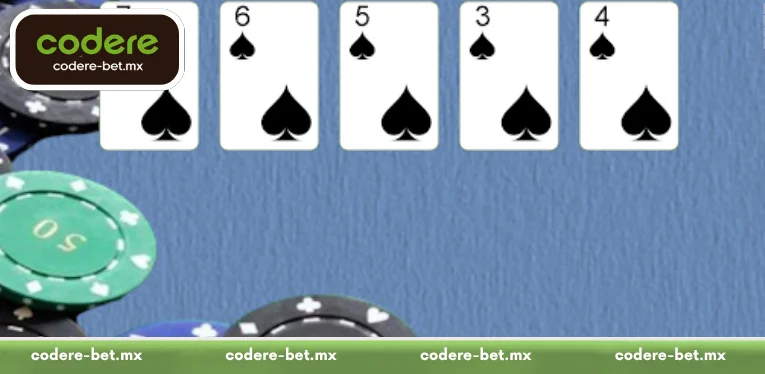
The magic of this variant lies in the “Information Gap.” Because you cannot see any of your opponent’s cards, your only clues to their hand strength are the number of cards they choose to discard and the size of their bets. For the Mexico market, Draw Poker offers a fast-paced environment where “Pure Bluffing” is a legitimate mechanical tool. It is a game of intuition and mathematical probability, providing a professional and historically rich experience for members who enjoy the “cat-and-mouse” nature of hidden-hand gaming.
The Journey of a Draw Poker Round at Codere
Participating in a high-stakes round requires more than just luck; it requires a disciplined adherence to the sequence of play. The platform is designed to make these transitions seamless, allowing you to focus entirely on your strategy.
Preparation and Receiving the Initial Hand
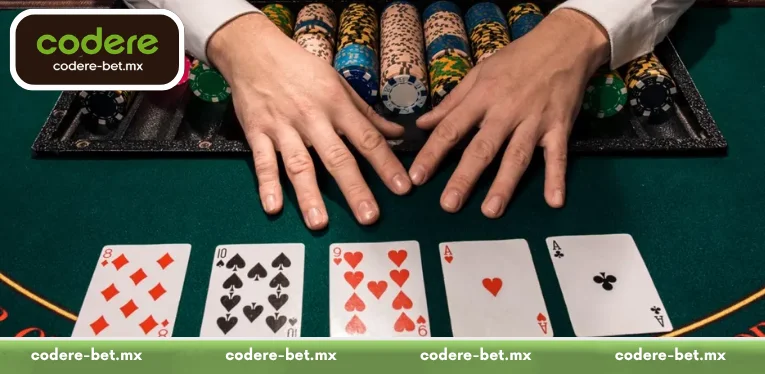
The round begins with the posting of forced bets. Depending on the table settings, this may be in the form of “Blinds” (Small and Big) or “Antes” (a small contribution from every player). Once the pot is established, the dealer distributes five private cards face-down to every participant.
- Hand Evaluation: Immediately upon receiving your cards, you must categorize your hand. Are you “Pat” (already holding a strong hand like a Straight or Flush)? Or are you “Drawing” (holding a pair or four cards to a sequence)?
- Initial Betting Round: Before any cards are swapped, the first betting round occurs. Players can Fold, Call, or Raise based purely on their starting five cards. This is a critical stage where you can represent strength even if your hand is weak.
The Intelligent Drawing Process
This is the defining mechanic of Draw Poker. After the first betting round, players who have not folded have the opportunity to discard any number of their cards (usually up to three, though some house rules allow four or five) and receive replacements from the deck.
- The Discard Choice: You must select which cards do not contribute to a winning hierarchy. For example, if you hold a Pair of Kings and three “junk” cards, you discard the three low cards to maximize your chances of hitting Three of a Kind or a Full House.
- Information Exchange: In the digital lobby, the software shows how many cards each opponent draws. This is a vital piece of data. A player who draws only one card is often chasing a high-value draw (like a Flush), while a player who “Stands Pat” (draws zero cards) is signaling a naturally strong hand.
- The Replacements: Once you click “Draw,” the software instantly replaces your discards, forming your final five-card hand.
Betting Rounds Before and After the Draw
Betting in this variant is divided into two distinct phases, each requiring a different psychological approach.
- Pre-Draw Betting: This is about “Range Building.” You are trying to thin the field or build the pot based on your potential. High-aggression here can force opponents with weak draws to fold before they even get a chance to improve.
- Post-Draw Betting: Once the new cards are received, the final and most intense betting round occurs. This is the “Showdown Prep.” There is no more information to be gained; you either have the winning hand or you must convince your opponent that you do.
- The Showdown: If two or more players remain after the final bet, they reveal their hidden cards. The highest five-card ranking wins the entire pot. If a player bets and everyone else folds, they take the pot without showing—a classic victory for the skilled blocker.
Strategic Decision-Making During the Draw
To secure a long-term profit in the Draw Poker lobby, you must treat the draw phase as a mathematical calculation rather than a guess. Professional players in Mexico use the following logic to dictate their discards:
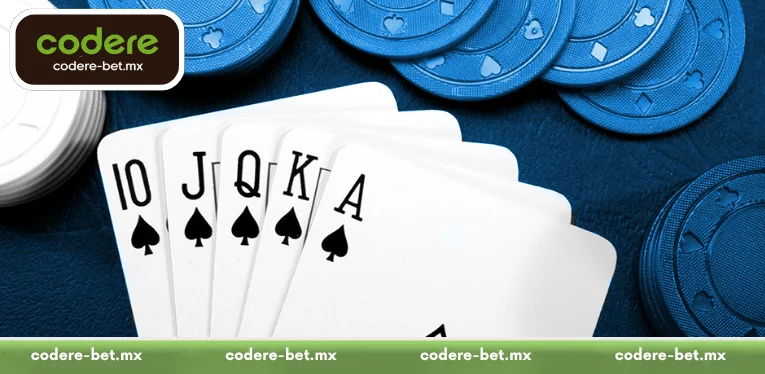
- Holding a Pair: The most common strategy is to keep the pair and draw three cards. This gives you the best statistical chance of improving to Three of a Kind. If you hold an “Ace Kicker” with your pair, some pros draw only two to disguise their hand, though this slightly lowers the odds of hitting the set.
- Drawing to a Flush or Straight: You should only draw if you have four cards to the sequence (an “Open-ended” draw). Never chase a “Gutshot” (needing one specific card in the middle) unless the pot odds are overwhelmingly in your favor.
- The Stand Pat Bluff: If you have absolutely nothing, sometimes the best move is to draw zero cards. This signals to the table that you have a “Made Hand” (like a Full House). If followed by a large bet in the final round, it is one of the most effective bluffs in the game.
- Three of a Kind Logic: When holding “Trips,” it is generally best to draw two cards. This maximizes your chance of hitting a Four of a Kind or a Full House, which are often the winning hands in high-stakes showdowns.
- Discarding the Entire Hand: If your starting hand is so weak that it has no pairs and no draw potential, it is usually better to Fold early. Saving your Mex$ for a better starting position is a hallmark of a professional member.
Conclusion
Ultimately, mastering the art of the hidden hand is a journey that rewards those who combine cold mathematics with a deep understanding of human psychology. By choosing a secure and localized platform for your sessions, you ensure that every discard and every raise is backed by world-class technology and fair play standards. Whether you are playing a quick casual round on your mobile or engaging in a high-stakes professional match, the classic appeal of Draw Poker at Codere remains unparalleled in the region. Always maintain a disciplined approach to your bankroll, play with a clear strategy, and enjoy the timeless thrill of outsmarting your opponents in the ultimate game of hidden cards.

Bárbara Mori lidera Codere en el mercado mexicano, ofreciendo una plataforma segura, confiable y optimizada con apuestas y promociones atractivas para jugadores.
- 📧 Email Support: [email protected]
- 🌏 Address: Benito Juárez 161, Tlalpan Centro I, Tlalpan, 14000 Ciudad de México, CDMX, México