
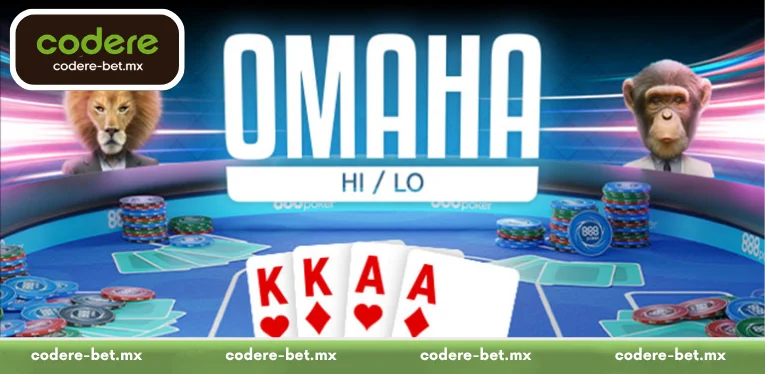
In the diverse ecosystem of professional card games, Omaha Hi-Lo (also known as Omaha 8 or Better) stands as the most intellectually demanding variant available to the public. For the strategic community in Mexico, this game offers a unique “split-pot” mechanic that allows for multiple winners in a single round. Unlike standard poker where one hand takes the entire pot, this version challenges players to simultaneously build the strongest “High” hand and the most qualifying “Low” hand. Mastering this dual-objective strategy at Codere requires a mechanical understanding of probability and a disciplined approach to hand selection. This guide provides an in-depth analysis of the split-pot rules, the criteria for qualifying low hands, and the advanced logistics of competing in this high-action arena using OXXO and SPEI.
Overview of Omaha Hi-Lo
Omaha Hi-Lo is a community card game played with a standard 52-card deck. Like standard Omaha, every player is dealt four private “hole cards,” and five community cards are dealt face-up in the center of the table. The defining characteristic of the “Hi-Lo” format is the division of the pot into two equal halves: 50% for the best High hand and 50% for the best qualifying Low hand.
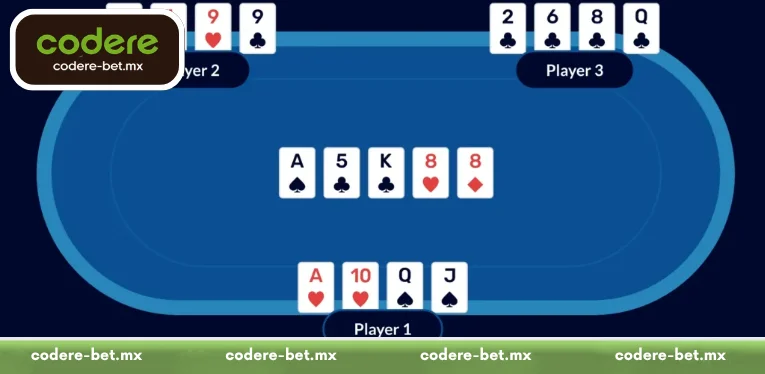
The game has seen a surge in popularity within the Mexico market because it reduces “variance” and allows for a strategy called “Scooping”—winning both the High and Low halves of the pot simultaneously. It is a game of extreme calculation where the “Nut” High hand might still only win half the money if an opponent holds a qualifying Low. Whether you are navigating a “Limit” or “Pot-Limit” table, the complexity of managing two distinct hand goals provides a professional and deeply rewarding experience for members who value logic over luck.
Basic Rules of Omaha Hi-Lo at Codere
To compete at a high level, you must adhere to the fundamental “2+3” rule common to all Omaha variants: you must use exactly two cards from your hand and exactly three cards from the community board. However, in Omaha Hi-Lo, you can use different combinations of two cards to form your High hand and your Low hand.
Qualifying a Valid Low Hand
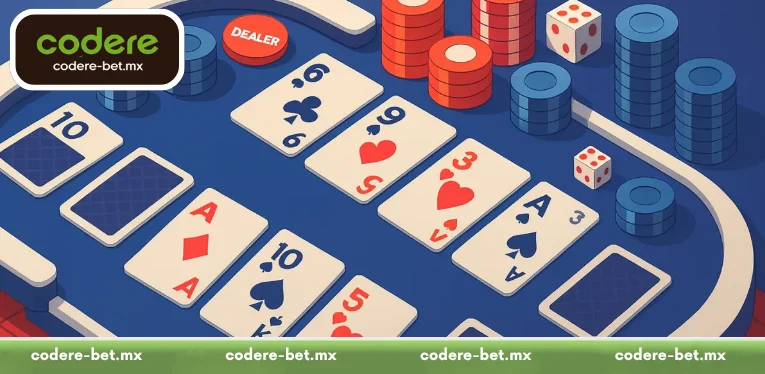
The “Hi-Lo” format typically uses the “8 or Better” rule. For a hand to qualify for the Low half of the pot, it must consist of five unpaired cards with values of 8 or lower.
- The “8 or Better” Requirement: Cards must be 8, 7, 6, 5, 4, 3, 2, or Ace. If the community board does not contain at least three unique cards of 8 or lower, there is no Low hand, and the High hand “Scoops” the entire pot.
- Aces are Dual-Purpose: In Omaha Hi-Lo, the Ace is the most powerful card because it acts as the highest card for the High hand and the lowest card (valued at 1) for the Low hand.
- Straights and Flushes: For the Low hand only, straights and flushes are ignored. This means a hand like A-2-3-4-5 is the best possible Low hand (the “Wheel”), even though it is also a straight for the High side.
Splitting the Pot Between High and Low
The logic of the “Split-Pot” is the core of the game’s professional appeal. At the showdown, the software automatically evaluates the eligibility of all remaining players.
- The 50/50 Split: If a qualifying Low hand exists, the pot is divided exactly in half. If multiple players have the same winning High hand, they split the High half. If multiple players have the same Low hand, they split the Low half (often called being “Quartered”).
- Scooping the Pot: The ultimate goal is to win both halves. This usually happens when you have the best High hand and there is no qualifying Low, or when your two-card combinations are strong enough to beat all opponents on both sides of the hierarchy.
- The “Emergency” Low: Professional players often aim for a strong High hand first, using a potential Low hand as a backup “insurance” policy to ensure they don’t lose their entire bet in a high-action round.
Priority Sequence for High and Low Hands
Understanding which hand takes priority during the reveal is essential for managing your Mex$ effectively.
- High Hand Ranking: This follows standard poker hierarchy (Royal Flush down to High Card). There is no “qualification” for the High hand; someone always wins the High half.
- Low Hand Ranking: Low hands are compared from the highest card downwards. For example, a “7-low” (7-5-4-3-2) beats an “8-low” (8-4-3-2-A). The “lower” the highest card in the five-card set, the stronger the Low hand.
- Independency of Hands: You can win the High half with two cards (e.g., K-K) and the Low half with two different cards (e.g., A-2), provided the board supports both combinations.
Popular Variants of Omaha Hi-Lo
While the “8 or Better” format is the most common, there are several variations that cater to different styles of play and risk tolerance among the Mexico community:
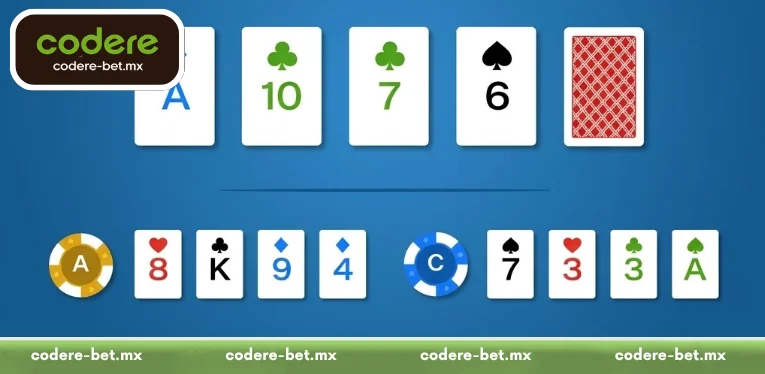
- Limit Omaha Hi-Lo: The most traditional format where bets and raises are restricted to fixed increments. This is highly strategic and favors “math-heavy” players who enjoy calculating pot odds for every draw.
- Pot-Limit Omaha Hi-Lo (PLO8): A high-action version where the maximum bet is the size of the current pot. This is significantly more volatile and is a favorite for members at Codere who enjoy putting maximum pressure on opponents with “wrap” draws.
- No-Limit Omaha Hi-Lo: A rare but extremely intense variant where players can go “All-in” at any time. This version requires extreme discipline, as one mistake can lead to losing your entire stack.
- Big O (5-Card Omaha Hi-Lo): In this version, players receive five hole cards instead of four. This exponentially increases the complexity and makes “Scooping” more common, as players have more flexibility to form dual hands.
- Mixed Game Formats: Often included in “H.O.R.S.E.” or other mixed rotations, where the game switches between Hi-Lo and other variants every few rounds to test the total versatility of the player.
Conclusion
Omaha Hi-Lo represents the perfect marriage of high-tech entertainment and traditional mechanics, offering a safe and visually captivating environment for anyone in Mexico looking for a professional and secure gaming experience. It is essential to remember that all betting should be done responsibly; therefore, we encourage all players to set a strict budget before playing and treat the game as a form of pure entertainment. For those who value a secure platform and high-speed mobile access, exploring the options available at Codere ensures you are engaging with the gold standard of live casino entertainment in the region.

Bárbara Mori lidera Codere en el mercado mexicano, ofreciendo una plataforma segura, confiable y optimizada con apuestas y promociones atractivas para jugadores.
- 📧 Email Support: [email protected]
- 🌏 Address: Benito Juárez 161, Tlalpan Centro I, Tlalpan, 14000 Ciudad de México, CDMX, México